 A child found my bones.
I imagined the catalyst of her discovery, surely similar to my own childhood explorations of the attic. Sprawling and filled with strange treasures, the attic was too great a curiosity.
Perhaps the rest of the family was busy unpacking boxes, so she climbed the creaky stairs, pushed open the tiny door. I pictured the attic untouched by time, dust layering every surface like snowfall. She peered through hatboxes, looked at peeling paintings, and pushed away the dressing screen, long faded into a dank mauve, once a brilliant pink with bursts of white flowers.
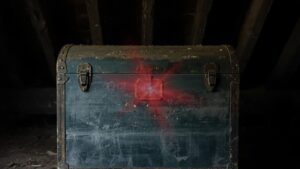
There lay the chest, ominously large, radiating feeble scents of cedar and rot. She bent to her knees reverently, and with all her adolescent strength, lifted the heavy lid. Oxygen rushed inside my makeshift grave, and she screamed at the anguished crescent arrangement of my bones.
***
The chest, painstakingly carved and gilded, had been my grandmother’s, a wedding gift from her father. After she died we kept it in the attic, filled with her letters and clothing, still thick with her lavender perfume. As a child, when my parents were distracted by their adult lives, I would scramble to the attic, unnoticed. I would wear my grandmother’s wedding veil, dressed in her high-necked silk dress, and read the letters written by my grandfather, poring over his dense, masculine cursive. At first, it was difficult to imagine my grandmother as a young woman, even when I stared at the faded black and white photos of her, smooth faced and slim waisted in her vintage clothes, scattered among her belongings. But with each letter I could feel her unfettered youth, her unrepressed love for my grandfather. I yearned for someone to write letters to me one day, with the same fervent romance my grandparents shared.
***
My wedding day was perfect. The heady scent of lilac hugged the air, complementing the purple and pink ribbons trimming each table. Beneath the balmy sun, guests mingled, the ladies holding lace parasols to protect their pale complexions. Pyramids of cucumber sandwiches, sugared pastries, and delicate chocolates crowded the refreshment tables; my mother’s beautiful crystal punch bowl held a sparkling pink punch, bubbling with champagne. I’d admired the bowl ever since I was a child, gazing at the intricate pineapple shaped patterns, the filigree arches along the rim, and the matching cups congregating around it, like delicate crystal chicks lingering beside an heirloom mother hen. For years, I’d imagined them at my wedding; on that day, I beamed when I saw the bowl catch the sunlight, as I walked toward my fiancé, his mouth a straight line.
***
He was the son of my father’s colleague, a respectable family with a derelict estate and an eminent name. I’d known him as a child, when we were both guests at various functions, but I never paid attention to him. He was ten years older and didn’t match my childish fantasies of a dark-haired, tall man with Valentino features.
His father suggested the marriage to my father over several rounds of scotch and cigars. My mother worried that at seventeen, I was too young, but my father, spurred by the prospect of such a prominent association, pressed for the pairing, and she relented.
He attended dinners with my family for the next few weeks, where we attempted many conversations. I tried to glimpse my future in him, and wondered if my children would be equally short in stature and rejoinders. Each night he lifted one of my gloved hands to his lips, bowed and said good night. I expected to feel something, perhaps a shudder or thrill in my spine, like the girls in the novels I consumed voraciously in candlelight. I only felt absence.
When he asked me to marry him as we walked in the gardens after an awkward dinner, I realized we had never really touched—he had never felt my skin. Only my gloves knew his kiss. I accepted, convincing myself that he’d become my grandfather in the letters I treasured, that we’d learn to adore each other, to crave unconstrained contact.
***
Buoyed by my mother’s zeal for creating a wedding enviable by everyone she had ever known, I busied myself with wedding preparations, displacing any apprehensive thought with cake flavors, flowers, and dress patterns. My father wryly commented on the extravagant planning, but with a dismissive wave of her hand, my mother reminded him of the tradition of the bride’s family covering nuptial expenses.
We ordered new dresses for the honeymoon to Europe, for which my father would pay, after my future father-in-law had mentioned a debt he had to address immediately, barring him from any contribution. As new packages arrived, my mother would layer dresses into traveling trunks, laying sprigs of lavender between tissue paper and fabric.
My fiancé told me we’d be living with his family for a while, until his finances were ready for our own home. My father scoffed at this plan–he would provide his only daughter with the proper residence, shuddering at inevitable society gossip if we were not properly established.
I’d imagined decorating our own home, planning our meals, sitting in our own parlor, learning each other’s habits. Questioning was never a part of my upbringing, so I agreed cheerfully, called him darling, and tried to ignore the strange taste of the word.
***
I floated in that dress. The fabric was sumptuous, starred with pearls, draped in delicate lace. My mother, through tears, had bequeathed me my grandmother’s ivory veil, the one I’d loved and envied for years. I was transfixed by my reflection, the sheer lace shaping my features in delicate waves.
In gloved hands, I clutched my bouquet, a reluctant gift from my fiancé’s father. He’d given me a dry kiss on the cheek as he passed them to me, begrudgingly muttering at their expense. I gazed at the strange bundle of deep magenta rhododendrons, pale pink striped oleander, and amethyst-dipped foxgloves, bending to inhale their fragrance. They smelled of nothing.
***
The moment I stepped down the aisle, the enchantment of the scene punctured any apprehension I had interred during the day’s bustling schedule: the lilting notes of harps and strings, rows of elegantly-attired guests, trees bursting with pink blossoms, the wealth of lace and ribbon festooning the arbor where I would soon echo his vows.
My father passed my arm to my fiancé’s, and as he lifted the veil from my face, I felt a slight spark of hope, just as the rain began to fall.
***
Servants dashed into the house with platters of food and soggy presents, followed by dripping guests carrying irritated expressions. Deftly my parents adapted the party indoors, as bottles of champagne were dispersed, diminishing quickly in tapered glasses.
My husband suggested the game.
The older guests declined, retiring to the sitting room for coffee, but the younger guests readily agreed to a game of hide and seek. My husband enthusiastically volunteered to be the seeker. His mood was contagious, and I felt a stirring of anticipation for our first night together, only hours away.
Giggles and rushing strides erupted as he began to count to one hundred. I waited until the room emptied, watching him count, his body fixed in the corner of the room.
I gathered the veil in my arms and ran, tiptoeing up the attic stairs. I lifted the lid of my grandmother’s chest, transferring her things onto the floor, and folded myself inside, carefully lowering the lid.
I counted to thirty before I heard the door creak open, the slow approach of footsteps. My heart pumped in my ears, and I held my breath in disbelief. How could he have found me so quickly?
My husband’s face appeared as the darkness ebbed with the rising lid. I conceded with a disappointed smile, and he smiled back.
“You’ve found me,” I said, shifting onto my elbow, slipping off my ivory embroidered gloves. I smiled shyly, extending a hand to my husband. He took mine. Skin to skin. Would he steal a moment to embrace me?
“No, I don’t think I have,” he replied, releasing my hand from his clammy palm. He reached for the lid, paused, smiled broadly, and slammed it upon my head. White stars ruptured my vision, then a black fog consumed me as I collapsed, the corner of my veil caught outside the chest, like a lace warning.
***
I awoke to a hammering pain in my skull, and for a moment, could not remember where I was. When I tried to sit up, the memory and the unaccommodating space seized me, and panic engulfed my lungs.
I called my husband’s name, hoping for an accident, trying to deny what I knew had to be true. I yelled for help, the word filling the chest like water. Then I screamed. Screamed until I could not breathe, until I sobbed. I pushed at the lid with all of my strength, but it did not move.
Time became confusing, mocking. I was desperate to hear the voices of my parents. Were they calling my name?
Between fitful moments of sleep, futile tears, and endless queries of why, I transformed from bride to animal. I clawed at the lid until my fingernails snapped, stuck in blood-lined gouges inside my cedar tomb.
My voice surrendered, strangled to an impotent whisper. In the silence, my body slackened, heavy and frail. I blinked away tears, staring at my bloody hands. My last breath was slower and more peaceful than I’d expected.
***
I was trapped in my dress, my skin, my bones. The scent of my decay conquered my grandmother’s lingering fragrance. The dress I’d adored, now nearly dust, chewed by intrepid insects, clung to mummified flesh. My hair peeled from my scalp, a brown coil beneath my skull, moldering inside my grandmother’s veil. My embroidered ivory shoes dangled lazily at skeletal feet. Time and silence were my companions, mocking me in their everlasting pledge. Sometimes I wondered which trap would be superior—a living, lonely marriage to my husband, or a lifeless marriage to time.
I don’t know how long my parents searched for me. I don’t know what happened to my husband. I don’t know how long I’ve been entombed. I knew only this chest, and the scream of the child who found me.
Sarah Rakel Orton, a native of Salt Lake City, Utah, is a graduate of the University of Utah’s Creative Writing MFA program. Her fairy tale retellings have appeared in multiple publications. Her short story, “Scars and Scales,” was nominated for Best New American Voices, and was published in The Sun Magazine. Her writing is inspired by fairy tales and folklore, and she is currently working on a short story collection of fairy tales reinterpreted through a horror lens. She lives with her five cats, one dog, two rambunctious boys, and a patient husband in the heart of Salt Lake City, in a home full of collectibles and too many books.
Published 2/14/26