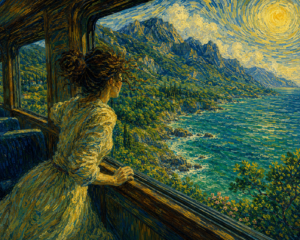
 The train rumbles forward, billowing through the dark tunnel, pushing out to the other side where the light beams bright. It lurches through the threshold before pumping its brakes, bringing the long chariot to a sleek, quiet speed, one of languid daydreams and faint lullabies. The train moves with silent grace, lulling me to sleep, but my eyes do not give in, for what is outside my window is too breathtaking to ignore. Too magnificent to be fooled into rest.
A green so vast, it climbs up, up, up, past the high arches that brush the clouds, then sweeps back down, reaching the turquoise sea with emerald stones. A green so deep and vibrant, it beckons me to unlatch my window and leap out, pirouetting through the lushness for all eternity.
The blue-green waves tumble, crashing into rocks, littering them with white foam. In and out it goes, scooping up pebbles for souvenirs.
The evergreen trees stand guard, preserving their beauty, protecting their innocence, their branches stretching long and wide, reaching to hold hands with their neighbors, bearing fruit to care for the little ones.
Oddly enough, there are no houses, no manufactured structures, no trees cut down to harbor selfish desires, no towers created out of greed, no boats or harbors, stores or power lines, water towers, paved roads or gas stations, no lawn mowers, fences, or chemicals.
Only an endless green erupting in bits of blue, pink, and gold. Created for bliss. For beauty.
A perfect Eden?
For me?
As the train grows more sedated, I unlatch the window and throw it open. The sun’s amber rays greet me in a warm embrace, while a light breeze wafts through the air, tossing the leaves in a whimsical dance. It soars through the blades of grass, leaping into the open window, rustling my hair. The loose strands of my curls tickle my cheeks as they dance with the foliage outside.
The train, barely coasting now, sways gently as I decide.
I stand.
I’m ready. To make the leap. To get off the train. To run to the top of the mountains and back down to the open sea.
Here I go.
But wait. What is this? Where am I?
Before the tunnel and the train, and the vast open sea made of sparkling emeralds and blue sapphires, and the thunderous, God-like mountains, I was tucking my kids into their beds, reading them a story, kissing their foreheads, sipping a cup of chamomile tea, and then lying myself down to sleep.
In my bed.
Asleep.
A dream, perhaps?
As quickly as it was built, the mountains and sea fade. The landscape erodes. The trees disappear. And I’m back in my bedroom atop my bed, alert and aware but stiff and unable to see.
Why can’t I move or open my eyes?
I try to lift my head. Nothing. Next, my arm. It doesn’t budge. Maybe a simple flicker of my pinky finger? Nope.
I lie there for hours, it seems, trying to lift myself up, but I can’t.
What could have happened to me? Am I experiencing sleep paralysis? No, otherwise, I could open my eyes, and I would be able to breathe…I’m not breathing.
I can’t breathe.
Now I understand.
This is my seven minutes.
I read about it not long ago while doom-scrolling on social media. An article reeled me in―a theory about death and how our extraordinary brain remains alive for seven minutes after every other organ has stopped functioning. Our remarkable brain then transports us to a heaven, creating a simulation for the seven minutes it takes our brain to shut down.
But mine is broken. My simulation stopped working. Now I’m left to experience death as it is.
How did I die? Heart failure, stroke, aneurysm, the chamomile tea my mother-in-law gifted me? It doesn’t really matter, does it? I’ll never know the answer if I don’t open my eyes.
Open your eyes. Open your eyes. Open your eyes, my brain screams.
I try to peel them open. But they won’t lift. All I see is black. A darkness so deep and cold it settles in and never leaves.
If I could just open my eyes, I would live. If I could just open my eyes, my kids won’t find a cold corpse upstairs in a once-warm bed.
My kids…alone and frightened for minutes or hours or days. Who knows how long? What if they starve? What if no one comes by to check on them? Their father won’t be home until the end of the week. He’s at a conference, a plane ride away. When he can’t reach me, will he catch an earlier flight or call Barbara, the mother-in-law from hell? She’ll be thrilled to find my body, blue and swollen, veins bulging. She’ll be the hero, of course, the grandmother who saved her grandchildren. Like she’s always wanted, people will praise her. The motherly role will pass to her, and she’ll finally get to raise them in the structure and order she ordained as truth. Oh, the joy my death will bring her.
No, no, no, my brain shrieks. You can’t let this happen. You can’t leave them alone with her. Open your eyes. Open your eyes.
With all my might, I try to peel back the tiny bits of flesh. Nothing flinches. Nothing moves. Only a black screen stares back.
My body. If I can move my body, I won’t die.
The brain does what the brain does: scampers about, ringing alarms, urging synapses to respond, to send the message down the brain stem along the spinal column, into the nerve endings, to move, to lift my body upright.
Move. Move. Move, my brain pleads.
But I can’t. I am stone.
When my kids come to cuddle for our morning snuggle time, their hands won’t find my soft, warm flesh. Instead, they’ll discover an icy, stiff lump in its place, and they’ll be stuck in this house with that rotting lump of a carcass until Barbara comes to take them away. What if there’s not enough food in the pantry to hold them over? When’s the last time I went grocery shopping? Did I buy enough snacks?
The cat.
What if they don’t feed the cat? The cat will get hungry, and it will know there is a dead body in the house just as it always senses the rats in the attic, and it will sniff out my pungent odor, licking its chops because I am meat now, no longer its owner. And then, my kids will be stuck in the house with their cat, who’s surviving off their dead mother. Oh, how the local newspaper will lap up this macabre story, casting Barbara as the savior.
C’mon, breathe, my brain cries. Do it for your children.
With all my might, I push every molecule of energy that may be hidden somewhere inside me into my limbs. I don’t budge.
I am trapped in my brain amongst shadows I can’t escape.
Why did I lift the veil? Give up my seven minutes of bliss for this hell? Why, oh why, did I need to know what was happening?
Now my kids will experience a trauma I swore to protect them from.
This can’t be their story. I won’t let death win. At least, not now. Not when they are at the tender ages of five and six. They won’t remember me from before, but there is a good chance they’ll remember finding their dead mother, cold and gray and bloated like the possum we discovered last week on our hike in the woods. Its tongue lopped to one side.
Move, move, move, my brain howls. Please, just move.
A grunt echoes from somewhere deep inside, bouncing over the gray layers that will only exist for another minute or two, maybe even seconds.
But when you’re stuck in nothingness, time expands and extends to eternity.
I am merely my thoughts now, which are deafening, screaming for me to save myself, to save my kids.
I make one last conscious effort, expelling every atom that makes me ME to my fingertips. Pushing harder than I’ve ever pushed before.
A bolt of electricity shoots simultaneously from my brain and heart, meeting in my spine and running down my circulatory system. A tingle spurts along the length of my arms into my hands, reaching the very tip of my index finger. A flicker of hope meets me there.
An involuntary shudder courses through me as my kids’ faces vanish.
Instead of a return to the fertile fairytale green, a perpetual, crisp silence greets me.
Dana began writing after she discovered its healing powers. She enjoys chasing her children around, crafting, and digging in her flower garden, which she tries very hard not to kill.
Published 5/10/26