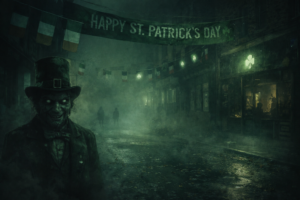
 It’s that time of the year. Shamrocks, leprechauns, and lots of green. These are all familiar symbols associated with Saint Patrick’s Day, the annual cultural and religious holiday celebrated on March 17 in honor of Ireland’s patron saint and all things Irish. But these are more than just tropes, and some of them have very dark histories.
On this sainted day, it is believed that the thin veil between the mortal world and the realm of the faeries grows thin, giving mystical beings access to our plane of existence. You’ve probably never seen a Leprechaun, but maybe you’ve heard tiny voices whispering along with the wind or seen a flickering presence in the shadows on the moonlit ground late at night.
Thinking of these otherworldly creatures might conjure up images of rainbows and pots of gold, but Leprechauns do more than frolic about and cackle playfully. According to Irish legend, leprechauns are not only mischievous, cunning, and manipulative, they can also be downright evil, even dangerous and violent to humans who cross their paths. These diminutive humanoid shoemakers are notoriously short-tempered and vengeful toward anyone they believed has done them wrong. It is not their stature or strength you need to be wary of, but their magical abilities. The curses they evoke can bring terrible misfortune to the disrespectful and greedy. The bad luck can last for several days or weeks depending on the severity of the perceived offense, with some victims suffering long-term physical afflictions. Leprechauns have been known to bring misfortune to entire families for generations.
Talk about holding a grudge.
Owing to their aggressive nature and territorial mentality, leprechauns can also be violent toward one another, often engaging in violent conflicts and even warfare.
Be thankful you never came across a leprechaun or his pot of gold.
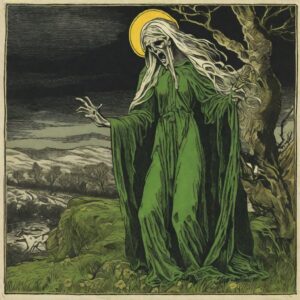 The banshee is another significant figure in Irish mythology that is often associated with Saint Patrick’s Day. This supernatural being takes the form of a shrieking – or sometimes singing – woman whose mournful melodies precede impending death.
Youngsters used to be told that if you hear a banshee, a member of the family will soon be dead, and if you see a banshee, you will be the one who is going to die. Mere mention of this dreaded spirit was enough to send shivers down the spines of the bravest souls.
Her sound could be a scream, a song, or even three knocks on the door. She may wear all red or green, have fiery eyes, and may fly. Some even say she might appear as an animal associated with witches in Irish folklore; a hooded crow, a hare, or a weasel. This spectral harbinger of death is said to roam the countryside on St. Patrick’s Day, and you definitely don’t want to hear or see the banshee on March 17, or any other day of the year.
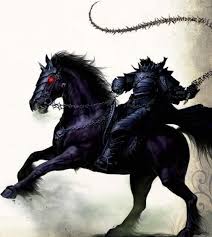 Perhaps even more terrifying is the Celtic mythological legend of the Dullahan, a headless rider who sits atop a black horse. With reins in one hand and a whip made from human spine in the other hand, the Dullahan rides forth on St. Patrick’s Day to claim the souls of the living, his hollow laughter echoing through the night.
So, this Saint Patrick’s Day, when the sun sets and moonlight stains the path that you’re walking down, be wary of the variety of spectral entities that can breach our world.
When it comes to the shamrock, a classic image of St. Parick’s Day, today it is considered good luck, but that was not always the case according to ancient folklore. In fact, the simple act of plucking a shamrock from the ground on St. Patrick’s Day was once believed to invite misfortune upon any soul who dared to disturb the sacred plant. The shamrock held a mystical significance, imbued with protective qualities against malevolent forces, so removing one on St. Patrick’s Day was seen as a violation of a sacred bond that invited the wrath of unseen spirits and supernatural beings.
Whether considered as a harbinger of luck or doom, the shamrock will always have a special place on St. Patrick’s Day.
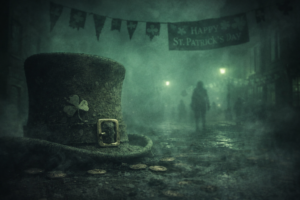 The color green on Saint Parick’s Day has a dark connotation as well. Green dye, green food, and green beer is a holiday tradition that harkens back the bitter history of Ireland’s darkest chapter. The Irish Potato Famine of the 1840s was triggered by a potato crop failure that was caused by a mold called Phytophthora infestans, which destroyed potato plants across the nation, devastating the staple food of an entire population. As a result, at least one million Irish died in the span of six years and forced many to flee their homeland in search of better times in America and elsewhere. Many stayed behind, however, and those who did turned to desperate measures to stay alive.
According to historian and founding director of Ireland’s Great Hunger Institute at Quinnipiac University, Christine Kinealy, “People were so deprived of food that they resorted to eating grass. In Irish folk memory, they talk about people’s mouths being green as they died.”
Published 3/12/26