 The bus drops Alannah off in front of the hospital. Her mother is near the entrance, sleeping in her wheelchair.
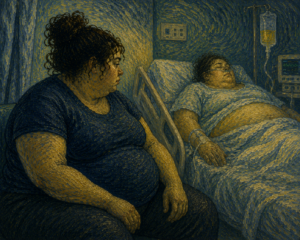
A hospital gown is draped over her gut, which is jaundiced and smothered in flab. Her heart worked overtime, like a fondue fountain, pumping cream and sauce through her veins. And her pancreas, a deoxygenated strawberry drowning in chocolate, quite literally. Her liver produces Mountain Dew colored bile that bubbles and fizzes because diabetes be damned, she wasn’t giving up soda. Her stomach grew from an archipelago of muscle to a continent of pinky fat. Screw the continent: her mother was practically a globe.
Alannah looks at her stomach.
She isn’t too far behind.
It started as a wayward slice of pie to calm her nerves. Mother required a lot of care, the sicker she got. Alannah didn’t want to cook anymore; McDonald’s was handier.
She watches her mother’s gut glide in and out of its cotton curtain and sees her own future. This is her fate.
She never expected to become like her mother.
Alannah works as a phlebotomist. She’s seen her share of fat men. One was so grotesque, his plasma came out alfredo white.. She looked at those plastic tubes in disbelief, watching the man slump into himself. His torso hung like a waterlogged linguini. His skin was basted in sweat, and he didn’t care about his health.
Her mother is going the same way.
That much is clear.
Alannah leaves her at the hospital and gets on the bus again, getting off at a random stop downtown. A man in head to toe sweat gear and a cheetah print backpack sings Mariah Carey and punches the air.
All I want for Christmas is you!
It’s July, not December, but this man doesn’t care. He probably doesn’t know what planet he’s on. Alannah envies him, and wants to join his chorus of madness. Instead, she walks aimlessly.
In front of an empty building, she sees a dog.
A German Shepherd on a leash has an empty Canada Dry bottle in his mouth. The owner, and older woman, pets his back as he growls at Alannah. “I don’t think she wants your bottle, Mortimer.”
Alannah loves animals with human names. Harold, my cat. Donna, my bird. Mortimer, my dog. How wonderfully anthropomorphic. As Mortimer walks away, she notes his waning belly. It can’t be safe for a dog that thin to walk. He looks otherwise happy; perhaps he’s sick and needs or merely enjoys his walk.
She thinks of her mother as she ambles around town, ending up in the grocery store, as always. Since beginning her caregiving journey, grocery stores are her last vice. When she’s not caring for her mother, she’s shopping for food. Food neither of them needs, but food nonetheless. Today, she buys croissants and donuts, a bag of pretzels and a two liter bottle of pop. She contemplates a loaf of bread knowing full well she’ll end up at the park. Bread is bad for the ducks, she remembers. She chooses frozen greens instead, hoping they’ll thaw in the sun.
She sits in the park for hours on end, feeding ducks from a bag of mushy peas. A flock of geese unfurl their necks until they’re stiff as saxophones honking and crying. Alannah throws them a handful of peas hoping they’ll go away. In true geese fashion, they do no such thing. The food emboldens them, “Honk, honk, honk!” They chase her from the bench into one further away. By the time she reaches it, she collapses on the wood.
She is so out of shape.
This could be easily remedied with a change in diet, a better exercise regimen. Alannah was never skinny, but a brief run was nothing in the past.
Alannah can see this particular future; it’s all but written in stone. Her mother will die on the second floor in the I.C.U. She will have complications from a heart attack or a kidney failure. She will crash, and it will be sudden. Resuscitation will prove futile. Alannah will be in the room with her. Despite threats of departure, she won’t leave her mother, even if she doesn’t change. She will continue from bedside to grave eating and drinking what she wants.
“I’m gonna die anyway, poor diet” her mother will say, eating McDonald’s and watching reruns of Dr. Phil. Though this was true — her mother had been sick for several years prior to her massive gain — Alannah hoped a diet would help.
Her mother seldom tried, shrugging her shoulders and finishing her meal. “I’m going to enjoy myself while I’m here, so don’t tell me what to do.”
Alannah doesn’t want to dwell on her mother’s demise. But now, an elephant sits on Alannah’s chest. It’s the same elephant that judged her mother from the corner chair in each hospital room. “Look at me,” it says. “You can’t ignore me anymore.”
She silences the elephant with a pastry.
When Alannah was small, she had a stuffed elephant gifted to her by a late grandmother. Its hide was pale pink and had eyes of fragile glass. It slept under her bed, a bright spot among dust bunnies. She thinks about it now, in the back of her closet.
As a young adult, her hips and breasts filled out, skin spilling out of floral bras and matronly underwear. She hated her body, as much as she loathed her mother’s. They stood like twin bowling pins; bottom heavy, awkward and pale.
No amount of dieting worked for Alannah or her mother, constant reminders from friends and family, “You’re getting chubby again,” only served to fuel their shame and their appetites. Alannah envisioned her stomach as an undiscovered mass of pallid land with a gulf coast of soda fizz and little creatures — gummy worms — a saccharine Cambrian explosion creating a new life in the absence of her real one. She hid herself more often than not. Her mother became the same as the years went by.
Alannah wonders when her mother’s fate will mirror her own.
***
Alannah gets back on the bus. It stops in front of a bar whose sign reads, “Your Great! Come inside and tell me about my grammar.”
The bar is mostly empty, save for the server and a gaggle of pot-bellied men. She considers ordering a beer, or something stronger. Normally, she doesn’t imbibe. Today is different.
Her mother’s going to die.
She approaches the bartender and orders a shot of Jose Cuervo and, to be safe, a cup of water. The shot goes down like a rotary cutter grating her esophagus. She sips the water slowly, watching soccer on the television. The men in the corner are playing a card game that has no decipherable rules. More minutes pass, and her ice cubes dilute and melt. She leaves the glass, sweaty and cold, on the counter top without a coaster.
There is a unisex bathroom with no toilet paper or working lock. Alannah uses her bag as a doorstop and tries to urinate. Nothing comes out. The toilet is too dirty to clear her mind enough to pee.
She washes her hands regardless, standing at the sink while water pools in her palms. It’s icy gray, not clear or blue. It smells like rust and rotten eggs. The soap is mostly bubbles. As she leaves the restroom, she feels dirtier than she went in, and her bladder is still full of soda pop. She pays her tab and leaves the bar without speaking a word to anyone.
Her mother is still waiting, and she’s eaten all her snacks.
Alannah is so empty, she’s walking on air.
She goes down the street to Publix, a grocery store with a scale in the front. She steps on and sees her weight: 287.5, give or take. She’s neither alarmed nor dismayed. This is her weight. Is she unhappy with herself? Approaching 300 pounds, maybe she should care more. But this is her body; a body like her mother’s.
Her mother will die, and she will still have this body. She isn’t sure what to make of that.
Alannah boards the bus one final time, heading to the hospital for good. The bus itself lights up in warning: WE ARE NOW APPROACHING– the announcement cut off by a glitch. At the hospital, no time has passed. Her mother sleeps outside like she’s already passed. When the woman stirs awake, Alannah calls them a cab.
“What took you so long?” her mother says.
Alannah tells her, “I went grocery shopping.”
Once back home, she enters her closet. The stuffed pink elephant sits in a box. White like a tumor, but rotted like flesh from the years of dust, and full of holes from moths and carpet beetle snacking. It is haunted and limp but still hers
She cuddles it close under her own doughy arm, holding it tight until mother calls for her insulin shots.
Anastasia Jill (they/she) is a queer writer living in Central Florida. They have been nominated for Best American Short Stories, The Pushcart Prize, and several other honors. Their work has been featured or is upcoming with Poets.org, Sundog Lit, Flash Fiction Online, Contemporary Verse 2, Orca, and more.
Published 5/10/26